


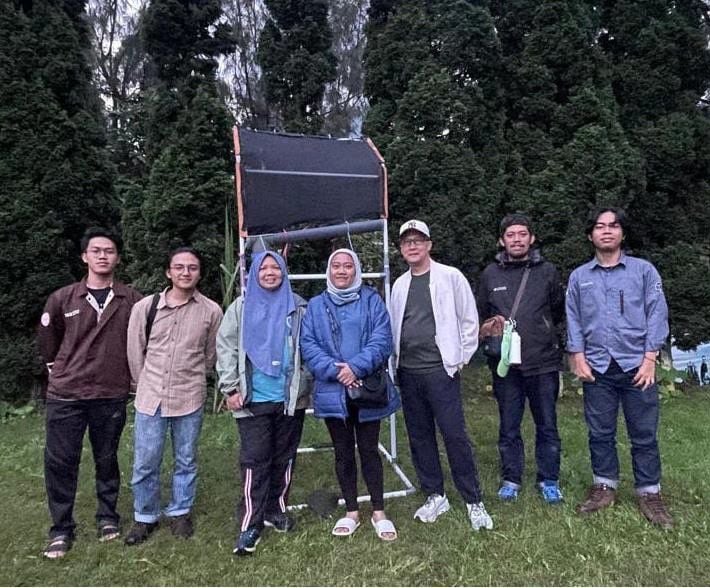
A Community Service Team from the Faculty of Earth Sciences and Technology (FITB) of the Bandung Institute of Technology (ITB) has developed a fog harvesting technology innovation in Wonotoro Village, Sukapura District, Probolinggo Regency, East Java.
This program represents a concrete step by academics in assisting communities to cope with the clean water crisis that frequently strikes the Mount Bromo tourism area, particularly during the dry season.
This community service program is led by Dr. Andri Hernandi, S.T., M.T., with team members Dr. Muhammad Rais Abdillah, S.Si., M.Sc., Dr. Susanna Nurdjaman, S.Si., M.T., and Dr. Ratri Widyastuti, S.T., M.T. The activity is supported through the FITB-ITB Community Service/Collaborative Innovation funding scheme.
Wonotoro Village, which serves as the gateway to Mount Bromo tourism, faces serious challenges during the dry season. Spring water discharge drops drastically from July to August, while the majority of residents do not yet have clean water pipe networks connected to their homes. This condition forces residents to fetch water directly from sources in the valley, and even endure long queues when the water volume decreases.
Observing this situation, the FITB-ITB team conducted an annual meteorological analysis using data from the nearest weather station. The study results indicate that despite low rainfall, relative air humidity is quite high—reaching over 80 percent from June to August—with low temperatures, creating ideal conditions for the implementation of fog harvesting technology.
During implementation, the team conducted field surveys, installed fog harvesting prototypes, and performed meteorological measurements using Automatic Weather Station (AWS) sensors alongside LiDAR-based spatial mapping. Field activities were accompanied by Wonotoro Village Head Sarwo Slamet and village officials, who provided support regarding water source conditions and potential application sites.
The collaboration also involves Johan Pramono, Director of Business Development and Corporate Strategy at Jiwa Jawa Indonesia, who is committed to the development of sustainable tourism villages in the Bromo region. This synergy between academics and the business sector is expected to provide sustainable solutions for the community.
Initial observation results showed relative humidity reaching over 90 percent in June 2025. However, high rainfall caused by a wet climate anomaly affected the effectiveness of fog capture. Low wind speeds also posed a challenge in the condensation process. These conditions prompted the team to conduct additional observations and design modifications to suit the atmospheric characteristics of the Tengger mountains.
Aside from weather factors, land limitation is another constraint. Most of the land in Wonotoro Village is privately owned, making large-scale fog net construction unfeasible. To address this, the FITB ITB team is currently developing a small-to-medium-scale fog net design that is more flexible and can be installed on residents’ land without disrupting agricultural activities or settlements.
Further research will involve Ir. Narendra Kurnia Putra, S.T., M.T., Ph.D., IPP. from the Faculty of Industrial Technology (FTI) ITB to examine structural aspects, materials, and energy efficiency of the fog harvesting system. Meanwhile, Miga Magenika Julian, S.T., M.T. from FITB ITB will conduct hydrological analysis and groundwater potential modeling to support integrated water resource management strategies.
Through LiDAR mapping, the team also successfully produced a Digital Terrain Model (DTM) to analyze river flow patterns and the distribution of springs in Wonotoro. Initial study results indicate that main sources are located in areas with low stream order, which are vulnerable to decreased discharge during the dry season.
Dr. Andri Hernandi emphasized that this activity is not merely technological research, but also an effort to build community awareness in managing water resources sustainably.
“We want to ensure that the research results are truly felt by the Wonotoro community and serve as the beginning of a long-term collaboration between academics, the community, and corporate partners,” said Dr. Andri in his official release to RRI Malang on Thursday (14/11/2025).
Meanwhile, exclusively via a text message to RRI Malang, Dr. Ratri Widyastuti, S.T., M.T., as part of the fog harvesting technology development team, added regarding the main technical challenges in adjusting the fog net design to be effective in the Tengger mountain region, which has different weather and topographic characteristics compared to the previous research location in Lembang.
“The main technical challenge is adjusting the material and structure of the net to the conditions of the Tengger mountains, which differ from Lembang. Because wind speeds in Tengger tend to be weak, we need materials with pores and surface properties that are more effective at capturing fog droplets at appropriate humidity levels.
The net structure must also be readjusted in terms of slope, density, and orientation so that it remains optimal even when the fog flow is not strong. In addition, the design needs to be combined with a rainwater harvesting system, enabling a single installation to efficiently harvest two water sources,” she stated.
Given the program’s objective to support clean water self-sufficiency and community empowerment, the FITB-ITB team’s strategy involves engaging the Wonotoro Village community so that this fog harvesting technology can be implemented and maintained sustainably after the research phase ends.
“Since the fog net is not yet optimal and still requires further development, we have focused community engagement on gathering comprehensive information about the conditions of Wonotoro Village—ranging from existing water sources and foggy locations to daily water needs. This information serves as an essential foundation to guide the development of more appropriate technology. In this way, the community remains involved from the outset as providers of local knowledge, before the technology is ready to be tested and applied,” she concluded.
With the spirit of collaboration and innovation, FITB ITB is committed to delivering science-based solutions to enhance water resilience in mountainous tourism areas vulnerable to climate change.

Portal berita resmi RRI.co.id menyajikan berita nasional, daerah, dan internasional terkini.
Discussion about this post