


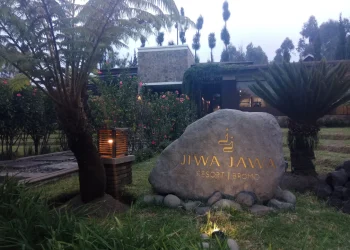
Having concluded his professional career as a banker, Sigit Pramono is well-known for his love of photography, particularly landscape photography. This hobby eventually led Sigit to discover a new passion: building hotels and organizing jazz festivals. His first hotel was Jiwa Jawa in the Bromo region.
In Bromo, Sigit initiated the Jazz Gunung Bromo event. Held in the open air at an altitude of approximately 2,000 meters above sea level, enveloped in mist and piercing cold, this ethnic-infused jazz festival has become a uniquely impressive artistic experience. More than 2,000 people travel from various cities and countries to enjoy it.
Since 2016, Sigit’s discerning touch has transformed a picturesque terraced rice field in Tamansari Village, at the foot of Mount Ijen in Banyuwangi Regency, into a tourist attraction known as Taman Gandrung Terakota (Terracotta Gandrung Park). The Jiwa Jawa hotel was subsequently built on the slopes of this hill.
How did Sigit discover this stunning location? And how did he build and manage it? Below is an excerpt from SWA Online’s interview with the former Chairman of PERBANAS, conducted amidst his busy schedule welcoming guests at Taman Gandrung Terakota some time ago:
After Bromo, you then chose this location. Why?
At the time, the Regent of Banyuwangi, Mr. Azwar Anas, attended and enjoyed Jazz Gunung Bromo, and he was captivated by it. He then approached me, expressing his desire for something similar—a jazz festival and hotel—to be established in Banyuwangi. I told him that if he could provide a location, I was ready to take it on. True to form, he is a man of swift action; two weeks after our meeting, he sent me photos of several locations—about four in total. I ultimately chose this one (Tamansari Village, Licin District, Banyuwangi).

Why build Gandrung statues? Because Gandrung is the identity of Banyuwangi. The Gandrung dance has undergone dynamic shifts throughout its history. It began as an offering dance from an agrarian society to Dewi Sri—also known as the goddess of fertility or the rice goddess—then evolved into a social dance, and eventually became one of Banyuwangi’s foremost artistic icons.
So, is this also an effort to erase the negative perception associated with the Gandrung dance?
Precisely, it functions as a rebranding. That is why these statues are placed amidst the rice fields; I want people to know that the dance originally stemmed from post-harvest thanksgiving celebrations. Following the harvest, farming communities would rejoice as an expression of gratitude for a successful agricultural season. Today, the Gandrung dance, hills, rice fields, and coffee have all become tourist attractions here.
Then why terracotta?
Terracotta is actually the Italian word for pottery, ceramics made from fired clay. It is inherently fragile and easily broken, but when it shatters, it returns to its original form: earth. Therefore, I did not want to build something eternal. The fragile nature of terracotta serves as a reminder to myself and anyone visiting here that nothing in life is permanent—from dust we come, and to dust we shall return.
What was the investment value for building this park and hotel?
From the very beginning, I did not approach this project based on profit-and-loss calculations or financial ROI relative to the capital invested. Instead, it is anchored in a return of happiness—on joy, on fulfillment derived from making a positive impact on the universe.
What is the total area of this property?
It is only about 4 hectares. Within this space, we house the Jiwa Jawa Ijen hotel and Taman Gandrung Terakota. This park serves as a site dedicated to preserving culture and nature. Therefore, the attractions we offer here include observing local farmers at work, coffee plantations, mangosteen orchards, a bamboo arboretum, and scheduled performances of the Meras Gandrung dance drama.

Which was built first, the hotel (Jiwa Jawa Ijen) or this park?
First, I built the hotel on the hillside. It was intentionally designed to be somewhat secluded, as its purpose is to provide a place for people to rest—not just their bodies, but their souls as well. Following the completion of the hotel, I then developed this park. I also built an amphitheater right in the middle of the park, bordered by rice fields. It was there, in September 2018, that we held the Jazz Gunung Ijen Festival.
How many spectators attended Jazz Gunung Ijen?
Around a thousand people. Attendance was intentionally capped to match the capacity of the amphitheater.
Will Jazz Gunung Ijen become a permanent fixture at Taman Gandrung Terakota?
Yes, it will become an annual event. In addition, we will also incorporate the rice harvest celebration—complete with Gandrung dancers—into our tourism calendar. By establishing scheduled tourism attractions, international visitors will be intrigued, knowing precisely when to visit to witness the performances they desire.

Berita bisnis terkini, Diaspora Indonesia, Business Champions dilengkapi dengan strategi dan praktek bisnis, manajemen, CSR, entrepreneur dan Youngster Inc

Discussion about this post